

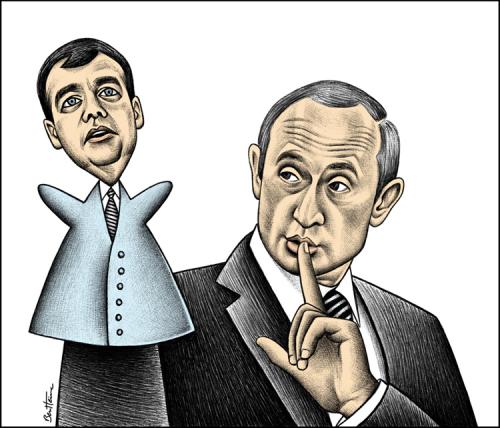
Vladimir Putin - Dmitri Medvedev
#7365 / 20120 mal angesehen
 9
9

Change You Cannot Believe In
Russia's new boss; same as the old boss
By Reuben F. Johnson
The election of a new Russian president should not be mistaken for a democratic transition. Vladimir Putin's hand-picked successor, First Deputy Prime Minister Dmitri Medvedev, ran almost unopposed, and there was little doubt as to the outcome. But Medvedev will now be the beneficiary of the most energetic Moscow PR campaign since KGB thug Yuri Andropov was reinvented as a Scotch-sipping, jazz-fancying liberal a quarter of a century ago. The goal will be to portray Medvedev as likely to make significant changes from the policies of the Putin years.
During the almost pantomime election campaign, Medvedev minimized interviews, taking only a token number of questions, and these only from a hand-picked pool of journalists who are, you might say, "in the tank-ski." They write tub-thumping stories about how Russia's future will be better and brighter under the new president.
For his part, Medvedev's statements have been laced with ambiguous platitudes and flowery rhetoric that make him sound like the ultimate civil libertarian. "We're talking about freedom in all its forms--personal freedom, economic freedom and, in the end, the freedom of self-expression," he said in a campaign speech. "One of the key elements in our work in the next four years will be ensuring the independence of the legal system from the executive and legislative branches of power."
This may earn Medvedev a fawning assessment from U.K. banks (looking to fill their coffers with the squirreledaway gains of senior Kremlin officials) and the Economist, but former Yukos Oil chairman Mikhail Khodorkovsky, for one, is
probably asking just what planet this freedom-spouting Russian president-elect has arrived from. The imprisoned Yukos boss sits rotting in a Siberian cell after a case in which it was clear to anyone not on the Kremlin payroll that the state controlled the judiciary's every move, dictated the verdict ahead of time, and engineered the rejection of his appeal in the fastest judicial decision in the history of Russia.
Independence of the legal system from the executive and legislative branches? This is like asking for a Moscow bureaucracy in which no one takes bribes and streets where drivers obey the traffic laws. To make a slight variation on the theme of Barack Obama's campaign, this is change that you cannot possibly believe in.
So the "Andropov is a closet liberal"-style charm offensive continues apace. "The university, with all its traditions, is his cradle," gushed Igor Bunin, the head of Moscow's Center for Political Technologies, in the Washington Post. Medvedev's "challenge is to lead Russia into the group of civilized countries. This idea is more important to Medvedev than the greatness of the country alone."
Other observers of Medvedev are a bit more objective. "After the campaign, I can say I know nothing about who he is," Georgy Bovt, the editor of Russia's Profil magazine was quoted in the Post as saying. "He is intelligent, well-bred, educated--that's all I can say. How is he going to manage the country? We don't know."
But the truth behind the selection of Medvedev by Putin and what to expect in the future can be heard from only a tiny handful of commentators. "Medvedev will be the glove on the hand of Putin's group," Dmitry Oreshkin, a Moscow-based political analyst, told the Post's Peter Finn. "The parliament is loyal to Putin. The security services are loyal to Putin. The mass media is Putin's. Any independent step by Medvedev will be considered a declaration of war on the current elite, and they will strike back."
Underlying this institutional control by the siloviki--the cabal of intelligence, military, and law enforcement officials who are in charge of the Kremlin--are two aspects of Russian power that have not changed since the Soviet era, or since the czars for that matter. One is that the struggle to succeed the man in charge does not begin when he steps aside (as Boris Yeltsin did at the tail end of 1999) or dies (which was usually the case in Soviet times). The top dogs are constantly jockeying for position, building their alliances and determining how to position themselves to take over long before an actual resignation, death, or election. Once the new man has taken over, his adversaries continue trying to block his moves, frustrate his initiatives, and otherwise keep him from taking actions not in their interests.
The other tendency is the one that perhaps best explains why Putin went outside of the inner circle of the siloviki and picked Medvedev, a St. Petersburg lawyer with no known ties to the intelligence services. Sergei Ivanov, a long-term KGB colleague of Putin's, had been seen as the favorite to succeed Putin for some time. He and -others of the siloviki are not pleased with Medvedev's appointment. But this suits Putin just fine. By turning his back on his own and elevating Medvedev, he encourages strife and internecine warfare. Both sides will then ask him to intercede. Like any good dictator, he realizes that his unique power to broker settlements will keep him pulling strings in the background.
Besides, the soon-to-be-former president has telegraphed his intentions with his statement about what his role will be when Medvedev appoints him prime minister--a position with no term limitations. "The cabinet, headed by the prime minister, is the highest executive authority in the country," Putin stated, which makes it clear that he will still be the man in charge no matter who occupies the president's office. As all government offices in Russia have a photo of the president hanging on the wall, this prompted the half-joke/half-query in Moscow: "Will Putin have a portrait of Medvedev on the wall in his office?" The question was put to Putin at a press conference, who called it trivial but said, no, he wouldn't.
Whether Medvedev really is a closet liberal or closet civil libertarian does not appear to matter. His own plans for changing Russia, if they exist, are more than likely to remain in the closet as well.
------------------
--> This opinion appeared on the Weekly Standard : http://www.weeklystandard.com
vladimirputinputindmitrimedvedevmedvedevbenheinerussiademocracypresidentialelectionspuppetpresidentdemocratiepeacebossgamejeushhhshuttransitionprimeministeroutcomereubenfjohnsonopinionredactioneditorialfamouspeo

Kommentare (7)
Kommentar hinzufügenMember
Thomas Bühler, am 01. February 2012 Beitrag melden antworten applause 0
Member
tejlor, am 04. June 2010 Beitrag melden antworten applause 0
Executive
BenHeine, am 06. September 2009 Beitrag melden antworten applause 0
Guest
nice work again :)
, am 06. September 2009 Beitrag melden antworten applause 0
Guest
, am 10. March 2008 Beitrag melden antworten applause 0
Deleted
, am 10. March 2008 Beitrag melden antworten applause 0
Member
Art Holland, am 10. March 2008 Beitrag melden antworten applause 0